Creates an hd object that accumulates geometry and presentation layers
via +, then renders when printed. This mirrors the way ggplot2 builds
plots: data mapping is declared first; visual decisions are added
incrementally; nothing is rendered until the object hits the console (or an
explicit print() / knit call).
Usage
hd(
  data = NULL,
  x = NULL,
  y = NULL,
  group = NULL,
  n = NULL,
  colour = NULL,
  mode = NULL,
  backend = lifecycle::deprecated()
)
Arguments
- data
A
data.frameor anhd_spec()object. When anhd_specis supplied every other mapping argument (x,y, …) is ignored - the spec carries them already. Default isNULL, which creates an empty data.frame.- x
Character. Column name for the x-axis variable. Ignored when
datais anhd_spec.- y
Character. Column name for the y-axis variable. Ignored when
datais anhd_spec.- group
Character or
NULL. Column used to split data into multiple series. Ignored whendatais anhd_spec.- n
Character or
NULL. Column of raw counts shown in highcharter tooltips alongside the y value. Ignored whendatais anhd_spec.- colour
Character or
NULL. ggplot2 colour aesthetic column. Defaults togroupwhenNULLandgroupis set. Ignored whendatais anhd_spec.- mode
Character. Rendering mode -
"dynamic"(default, interactive) or"static"."dynamic"uses the highcharter backend,"static"uses the ggplot2 backend and others. Seelist_modes().- backend
Character. Rendering engine -
"dynamic"(default, interactive) or"static", or any engine added withregister_backend(). Falls back togetOption("highdir.backend", "dynamic"). This will deprecated in favor ofmodein a future release.
Details
hd() accepts either raw data columns or an existing hd_spec() object.
Passing an hd_spec is the recommended bridge for code that already
constructs specs separately (e.g. in Shiny or a reporting pipeline).
Examples
df <- data.frame(
  age = rep(c("18-24", "25-34", "35-44", "45-54"), each = 2),
  sex = rep(c("Male", "Female"), 4),
  pct = c(42, 38, 55, 61, 48, 52, 60, 57),
  n   = c(120, 115, 200, 210, 180, 175, 160, 155)
)

# Composable style
hd(df, x = "age", y = "pct", group = "sex") +
  hd_geom_column() +
  hd_opts(title = "Health survey", ylim = c(0, 80))
#> Registered S3 method overwritten by 'quantmod':
#>   method            from
#>   as.zoo.data.frame zoo

# Pass an existing hd_spec
spec <- hd_spec(df, x = "age", y = "pct", group = "sex", n = "n")
hd(spec) +
  hd_geom_line(smooth = TRUE) +
  hd_opts(title = "Trend")

# Switch backend per figure
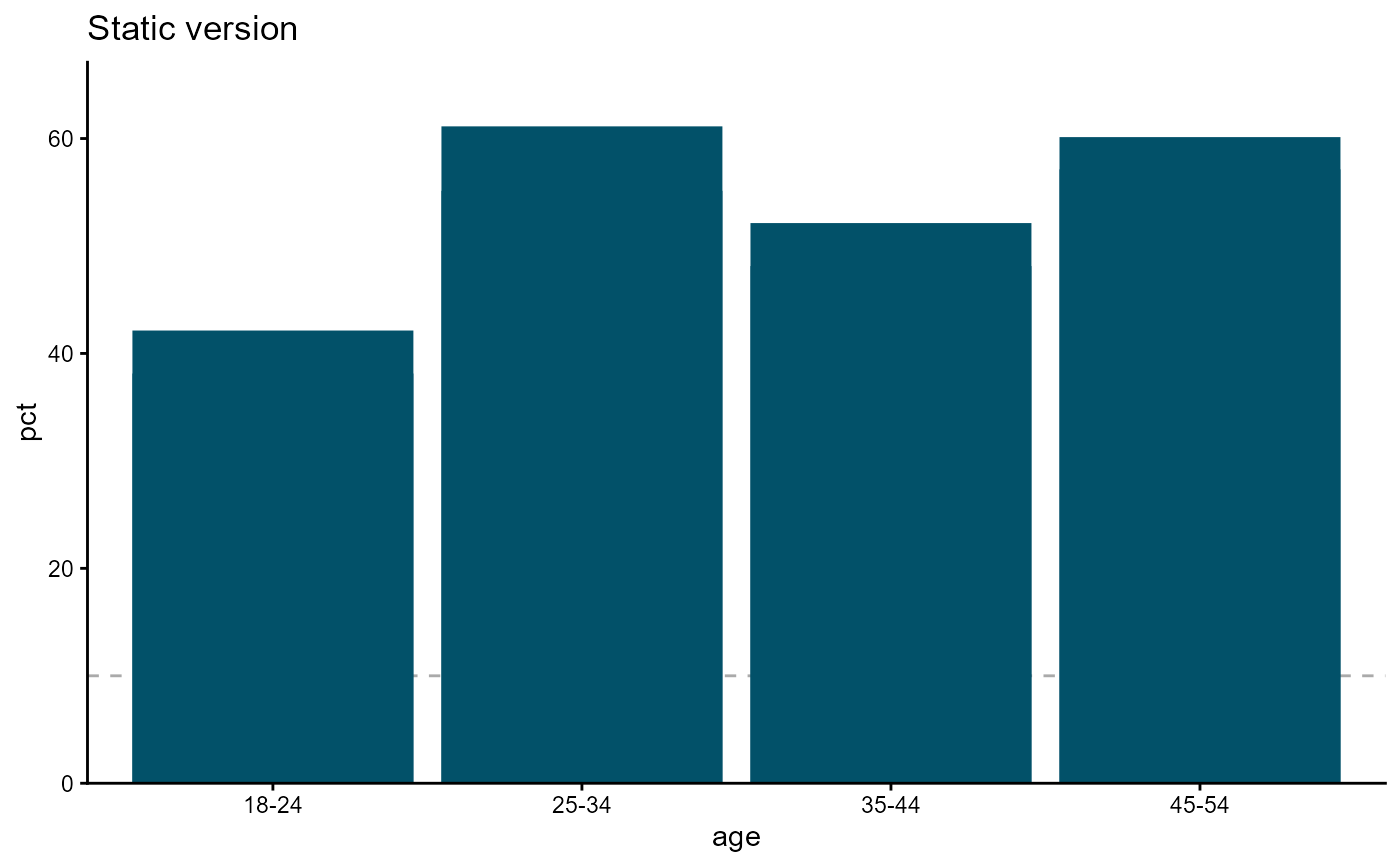
hd(df, x = "age", y = "pct", mode = "static") +
  hd_geom_column() +
  hd_opts(title = "Static version")